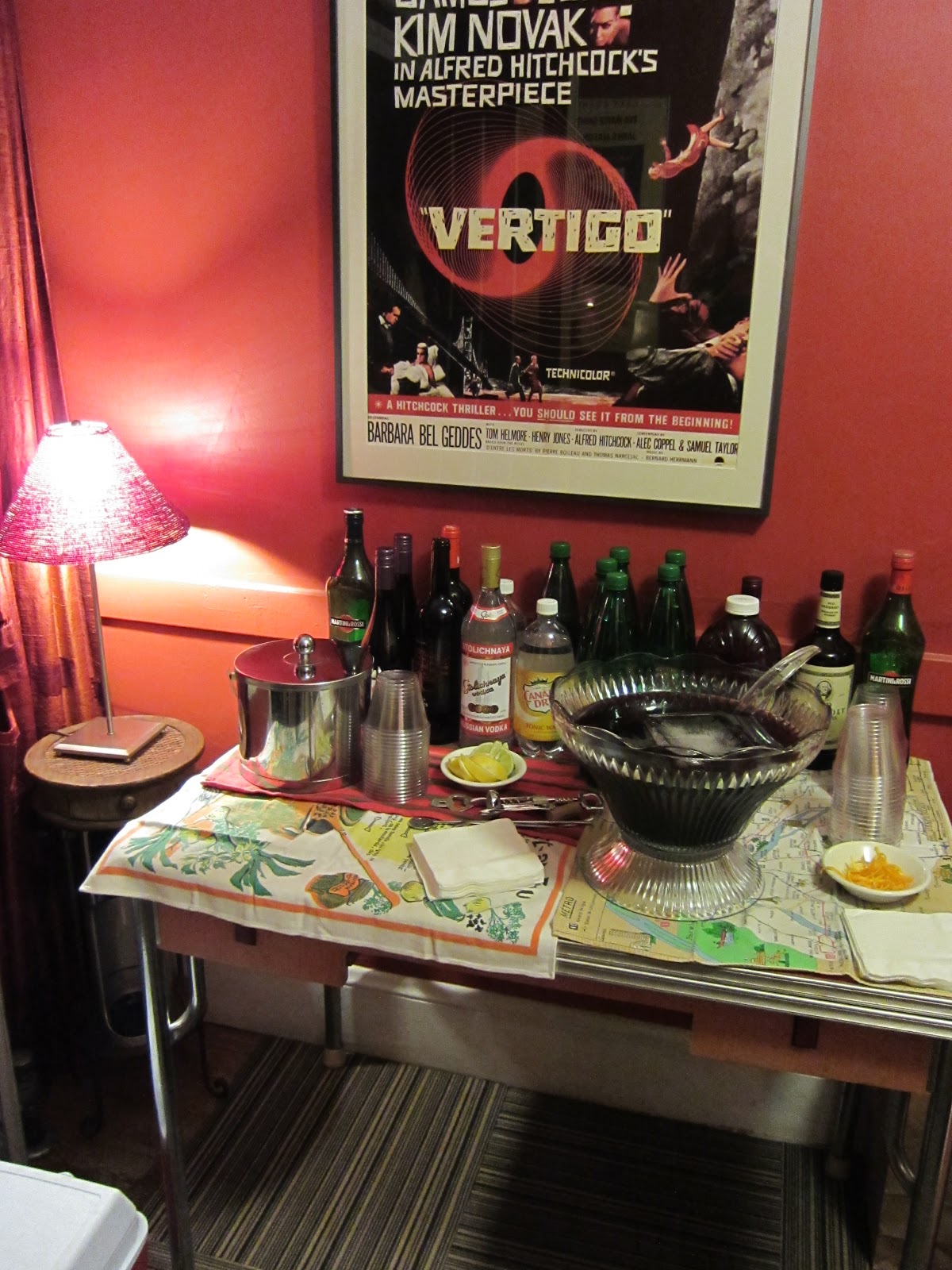
Showing posts with label Angostura Bitters. Show all posts

Sunday, October 25, 2015

The Whittemore Sipper

After some midlife upheaval, I now live in a strange oasis called the Whittemore Estates. This is a hidden secret of Boston, a rambling property of flagstone and apple trees, vegetable gardens and a rich abundance of flowers. There is also a quite remarkable swimming pool, certainly an anomaly in Boston, that brings to mind the south of France, or at the very least, a summer vacation spot in Maine or Cape Cod.


It is now October and the pool is forlorn and covered. We are heading toward Halloween. Days have become cooler, the nights downright chilly, and the apples are falling off the trees en masse. The air is redolent of their broken flesh, of woodfire and damp leaves. 

In homage of this magical place, I have a cocktail to share. Based loosely on a cocktail by Jay Zimmerman of Brooklyn's ba'sik, the Whittemore Sipper is, as is my wont, a twist on the Manhattan using rye whiskey, Orchard Apricot Liqueur, and Byrrh Grand Quinquina (an aperitif flavored with quinine—which comes from chinchona bark—and has flavors reminiscent of finer vermouths, but with a gentle bitterness). To this I add a combination of bitters, and a flamed orange peel. 

I have played around with this cocktail quite a bit, veering away from my first choice of Punt y Mes vermouth, which is a bit too heavily bittersweet (in my opinion) for this drink, and opting eventually for the gentler Byrrh, which has tones (such as chocolate) that complement the apricot and rye nicely. You could substitute the very fine Bonal Gentiane Qiuna, another quinine-derived aperitif (and a key ingredient in the Bonal & Rye cocktail). 

Go easy on the apricot liqueur—at least if you are using the Rothman & Winter Orchard Apricot—as it can be a bit medicinal if overused. And find a rye that has punch. I have been using 100-proof Hochstadter's Vatted Straight Rye Whiskey, but the 100-proof Rittenhouse Rye works well too. I'm sure even Old Overholt would work, in a pinch, but the rye flavors—all the flavors, in fact—are more muted.

Also, I have played around with bitters, starting with Regan's Orange Bitters and moving to Dutch's Colonial Cocktail Bitters and a few others. I settled on a combination of the unshakeable Angostura Bitters and Bittermen's Xocalatl Mole Bitters, which adds suitable depth and complementary flavors to the drink. However, part of the fun is experimenting, so perhaps there are other types of bitters that would bring out different flavor profiles in this drink.

Experiments are underway employing a rinse of smoky scotch, and the verdict is out. But, again, this is why drinking is fun. Without further ado, the recipe.

The Whittemore Sipper
  • 3 oz rye whiskey
  • 3/4 oz Byrrh Grand Quinquina
  • 1/2 oz apricot liqueur
  • 2 dashes Bittermen's Xocalatl Mole Bitters
  • 1 dash Angostura Bitters
  • Flamed orange peel
In a mixing glass with ice, combine all the ingredients except the flamed orange peel. Stir until very cold and strain in to a cocktail glass. Flame the peel (see how to flame a peel) over the drink and discard the peel. Drink the drink. Bottoms up.

And, please don't hesitate to provide your feedback on this recipe.

Saturday, January 24, 2015

The Wise Manhattan Cocktail


While this compendium of cocktails is not intended to be a forum for home-invented drinks, there are a few exceptions: the Night Tripper, the Bucking Bronco, the Shangri-La, the Dirty Cur, the Elmwood Sour, and the Whittemore Sipper.

To that short list of bespoke drinks I add one more: The Wise Manhattan. This is a good one, I promise -- if you can find the proper ingredients (which I urge you to do). 

First, lay your hands on some Riga Black Balsam bitters. It comes in a fetching ceramic bottle and has an alcohol content of 45%. To date, I have not really found a good use for these bitters, acquired under duress at one eccentrically curated liquor store. Here is how they are described by the company JSC Latvijas balzamson on their website:
Riga Black Balsam opens a whole world of sensations with its 24 ingredients. Subtle hints of linden blossom, birch bud, valerian root, raspberry, bilberry, and ginger as well as touches of nutmeg and black peppercorn tease the palate and come alive in the glass. 
Now -- with this cocktail -- the fate of my lone bottle of Riga Black Balsam bitters is sealed.

You'll also need to get hold of some walnut liqueur (noix in France, nocino in Italy, nüsse or nüssenschnaps in Austria and Germany). It is made from steeping unripe, green walnuts in a spirit. It is black, sticky, and bitter. The only brand I have used is Nux Alpina Walnut Liqueur, made by Austria's Distillerie Purkhart and described as "unique for its use of alpine botanicals and renowned for its balance and exceptionally smooth finish." While I am not generally the most outspoken fan of walnuts, I admit that this liqueur is quite tasty, and works well with bourbon.

The other necessary ingredient is sherry. Not a dry sherry (though I believe there are angles to be explored there) but Pedro Ximénez, or "PX," which is a rather sweet dessert wine. It has a compelling scent of raisins (or prunes) and molasses, and functions much as a sweet vermouth might in a regular Manhattan, providing the spicy whiskey with an underlying bed of candied dry fruit, burnt sugar, and mocha notes -- complementing the walnut liqueur quite favorably, and benefitting from the balancing herbal notes of the Riga Black Balsam bitters. I found a small bottle of 2013 Pedro Ximénez made by Alvear, about $25, without too much searching. It is beguiling on its own, but its flavors really add layers of nuance to this Manhattan-like cocktail.

Together, these three unusual ingredients -- sweet and bitter -- work marvelously with bourbon, creating a cocktail with a sultry depth. The drink evokes the tobacco and leather of a comfy old manor library with oriental rugs and crystal decanters. Or maybe that is just my fancy. I found burnt sugar, dried fruit (raisins and prunes), spices, and a subtle yet clear and pleasant walnut aftertaste. The sweet is balanced by the walnut and bitters, all of which enhance the bourbon (I used Johnny Drum, 101 proof and deliciously spicy). But in my limited connoisseurship, let it suffice to say it is satisfying, deep, and tasty.

So, why the "Wise" Manhattan?

It is thought that the walnut traces back to Persia. According to the site USA Walnuts, "Walnuts are one of the world’s oldest foods and have been cultivated for at least 2,000 years. These nutritious nuts have been linked to love and fertility throughout history and their reputation as an aphrodisiac dates back to ancient Greece and Rome." Sexy! There are a lot of fascinating details about walnuts and what they symbolize on the USA Walnuts site. You can also find some background on the symbolism of the walnut tree here.

1939, © Fritz Kahn
Quoted from USA Walnuts:
Walnuts were considered beneficial for any disease affecting the head since early on because a whole walnut and the walnut meat within the shell both resemble a wrinkled human brain. According to the Doctrine of Signatures, a 14th century medical theory that theorized that a plant’s shape suggested its curative properties, eating walnuts was believed to stimulate the intellect. Walnut husks were used in folk medicine for the scalp, and walnut shells were recommended for skull ailments. In floriography, the language of flowers, walnuts represent the intellect.
Moreover: "We discovered that students who consumed walnuts experienced improvement in critical thinking, specifically inferential reasoning," says Peter Pribis, Andrews University associate professor of nutrition and wellness, who led a study on the "Effects of Walnut Consumption on Cognitive Performance in Young Adults," published in the British Journal of Nutrition.

So, in other words, walnuts might make you wiser. This is nuts, you must think. Well, let's get to the recipe.

The Wise Manhattan

  • 3 oz bourbon
  • 1/2 oz Pedro Ximénez
  • 1/4 oz Nux Alpina Walnut Liqueur (or other walnut liqueur)
  • 1/2 barspoon Riga Black Balsam bitters (or to taste)
    (substitute Angostura if necessary, or Black Mission Fig bitters by Brooklyn Hemispherical)

Stir with ice in a mixing glass until very cold. Strain into a cocktail glass and garnish with a cocktail cherry. Though they are expensive, I recommend using the Luxardo Maraschino cherries in syrup.

Now, raise the glass to your nose and take a deep whiff. Savor the aroma. Clink your glass, and bottoms up!

"I don't categorically hate nuts. I just don't like them in my mouth."


Sunday, December 21, 2014

And to All a Good Night


I managed one post last year and I will manage one again, this year. You can all blame the mighty Manhattan for my absence, for I have been sunk in its ever-evolving charms and comforting elegance throughout the past year. 

Now, however, that is beside the point. I am in the throes of addiction to a new magic.

It is December 21, 2014. The Winter Solstice. The Winter Solstice marks the longest night of the year. And this year, it will be the longest night in "the history of earth" (according to science -- or not). So, on the cusp of the longest night in 4.5 billion years, I am here to tell you about a spicy little number called, fittingly, And to All a Good Night. 

Forget that Christmas poem. At least, you will once a few of these have lubricated your puzzler. Attributed to Tim Stookey of the Presidio Social Club in San Francisco, this cocktail with the unwieldy name has won my heart over the past few weeks. And, it is a truly unusual tipple in that it brazenly mixes bourbon (or rye) with tequila. And then throws in a bit of Cherry Heering. On paper this sounds truly unpleasant, but not so much that I wasn't intrigued. So I got to work.

Some recommendations for liquor: First of all, while this was originally billed with bourbon, I can tell you that, so far, this has worked best for me with a nice, strong, spicy rye. I used Bulleit and it definitely added some nuances that were lost to Old Overholt. I would opt for a similar route with bourbon--go for something with a little oomph in the spice department. As for the tequila, I used a Espolón reposado, which worked nicely. I haven't experimented too much with different reposados, but it would be worth the effort I think. Then you have your Cherry Heering (no substitutes) and your bitters. I tried this with Angostura Orange bitters, and it fell short. You really will benefit from the Regan's orange bitters. They demonstrate more peel bitterness, and have quite a bite. Then a dash of Angostura bitters for that distinctive depth. Obviously, tastes differ -- which is why it is fun to play around with these cocktail recipes.

So what would such a mix of ingredients taste like? I was surprised. First of all, the orange oils from the garnish give this a sumptuous, magical bouquet. And each sip revealed (to these taste buds, at least) the richness of chocolate; a deep, dark hint of cherry fruit; and a lot of spiciness--using Bulleit rye I found a range of sparkling, palate-rousing mint, cinnamon, cocoa, pepper, vanilla. The tequila will add its own complimentary notes, which in retrospect is not so surprising, considering it too is aged in wood and carries a spicy whomp. 

The marvel, with this drink, is how all the flavors blend together into a most harmonious whole. Exactly as it should be with a superlative cocktail. So, my lovelies, get to work.

And to All a Good Night
  • 1 1/2 oz bourbon or rye 
  • 3/4 oz reposado tequila 
  • 3/4 oz Cherry Heering
  • 2 dashes Regan's orange bitters 
  • 1 dash Angostura bitters
  • Orange twist 
Combine the ingredients in a mixing glass with ice and stir until cold. Strain into a glass, take a swath of orange peel and gently spritz the oil across the surface (you can even try flaming it), deposit the peel in the glass, lift it to your lips, tilt the glass gently to no more than a 45 degree angle (toward your mouth, of course), and savor.

"Happy Christmas to all, and to all a good-night!" And, I say, bottoms up.


Monday, October 29, 2012

Widow's Kiss


As Halloween approaches, I thought I would post a peculiar tipple made of almost ancient potions, called the Widow's Kiss. Not really a spooky drink, though the "widow" must have had some fortitude--this is a potent cocktail.

One sip at a time, this widow's kiss is a touch of heaven on the lips.

The Widow's Kiss has been spoken of highly by David Wondrich ("astonishingly harmonious and yet intriguing") and Dr. Cocktail himself, Ted Haigh ("the most evocative drink ever"). Therefore, I had to put this to the test.

The printed recipe dates back to 1895, and from all appearances comes from the hand of one George Kappeler. Two of its ingredients--Chartreuse and Benedictine--are assertively herbal, and date back to 1605 and 1510, respectively, when they were employed "medicinally" by the monks who crafted them. Additionally, there are Angostura Bitters, also herbal in nature, which serve to take the edge off the sweeter ingredients.

Then, there's apple brandy. That makes this a suitable drink for autumn as we head into the colder months. While Calvados is suggested, I find that using Laird's bottled-in-bond, 100-proof straight apple brandy is just fine. The only trouble is finding it--you may be able to find Laird's Applejack, but it is not the same beast. Advice is to defer to Calvados if your only alternative is applejack.

A note about Green Chartreuse, also: Some advise yellow Chartreuse in this recipe. It is lower proof and not as assertive. I don't know. The green version is strong-willed, so the argument is that it can overpower the drink. Nonetheless, I like using the green version. 

It's strong. It's herbal. Potent. The Benedictine and the Chartreuse combine with the apple brandy to create a complex flavor, reminiscent of anise but veering away from that, into alpine herbs. It is a very full flavor, with a lot of tingle. It can be a little viscous and heavy, but you don't want to rush through this. Savor this kiss.

The Widow's Kiss
  • 1 1/2 oz apple brandy (Laird's bonded straight apple brandy or French Calvados)
  • 3/4 oz Chartreuse (I use the green, but yellow is advised by Wondrich)
  • 3/4 oz Benedictine
  • 2 dashes Angostura Bitters
Shake with ice and strain into a cocktail glass. The Widow's Kiss is garnished with a cherry, and when it finds its way to your mouth you will possibly swoon. It's a delight. Bottoms up!

Monday, December 12, 2011

Punch Drunk

Punch is fun. And it makes an especially good party offering, as the hosts don't have to spend their evening "behind the bar," so to speak, but can mingle freely with their guests. Well, actually, it is usually only served at parties nowadays, though once upon a time it was a standard libation. You just don't see it that much anymore.

The main problem is finding punches that are interesting, and also not too sweet. Because so often, punches are made (or refreshed mid-party) by people who have already had way too much to drink - I am sure you have seen it: A soused host debonairly dumping sickly sweet rum into some sort of sickly sweet juice, concocting a recipe for one of the worst headaches in the world.

So, after some years, I have refined my list of punch recipes to just a few. And of those, these two are the best. They are deeply flavorful, complex, and not too sweet. They work wonderfully as holiday party punches, but are not limited to that service.

By the way, here is a good book about the history of punch by David Wondrich.

Without further ado:

Kentucky Cardinal Punch
Courtesy of Imbibe Magazine.

Says Imbibe, succinctly: "This punch from Kentucky bartender Kyle Higgins gets a strong fruity backbone from Southern Belle shiraz, a robust Australian wine aged in used Pappy Van Winkle whiskey barrels." 

It was incredibly difficult for me to track down this wine. Originating from Australia's R Wines Winery, I finally found a distributor in New York (and reasonably priced, too). I had a friend lug up a few bottles. In any case, I have not seen any since. I am sure nothing tastes quite like it (thanks to that aging in Pappy van Winkle bourbon whiskey barrels), so choose whatever bold wine you can find and don't expend energy on regret.


8 cups Southern Belle Shiraz, or other bold, spicy red
2 cups rye whiskey
2 cups brandy
1 cup sweet vermouth
1/2 cup Carpano Antica
1 lb granulated sugar
2 cups Moscato d’Asti
8 cups sparkling water
Ice block (freeze water in a Bundt cake or loaf pan)
Garnish with orange twists

Combine shiraz, rye, brandy, vermouth and Carpano in a pitcher. Slowly stir in the sugar until dissolved. Refrigerate for several hours until cold. When ready to serve, place ice block in punch bowl and pour chilled mixture over. Top with moscato and soda water and serve. Garnish each serving with an orange twist.
Makes approximately 50 servings.

Bourbon Punch with Pink Grapefruit and Mint
Courtesy of Melissa Clark, Bon Appetit. Makes 8 to 10 servings.

This is quite an interesting punch. Sort of a mix between a Mint Julep and Brown Derby. It is not too sweet, and has a tart, citrusy sparkle to it, thanks to the mingling grapefruit, mint, and club soda. The ingredients may seem a bit unusual, but this was a successful punch at one of my holiday parties. Very flavorful and with mass appeal. I doubled this recipe.
Hors d'oeuvres
  • 1/3 cup water
  • 1/3 cup sugar
  • 15 fresh mint sprigs, divided
  • 4 cups strained fresh pink grapefruit juice
  • 2 1/2 cups bourbon
  • 12 dashes angostura bitters
  • 1 cup club soda
Stir 1/3 cup water and sugar in small saucepan over low heat until sugar dissolves. Increase heat and bring to boil. Add five fresh mint sprigs. Remove from heat; cool syrup completely.

Strain syrup into punch bowl. Add juice, bourbon, and bitters; mix in soda and 10 mint sprigs. Add a block of ice to bowl.

A note about ice blocks: You want an arctic hunk of ice. While you can certainly buy blocks of ice, it is is easy to use a large Tupperware container, or as suggested above, a Bundt pan, to create a frozen block or ring of ice. Just freeze the water over night or longer to be sure it is solid! Have a backup ready, too, in case the first block melts too much.

If you are not serving the punch immediately, keep it refrigerated until you are ready to serve, and then add the ice to the punch bowl. Yes, you need a punch bowl. Bottoms up!

Whoa, whoa!

Tuesday, November 15, 2011

Romeo & Juliet Manhattan

Parting is such sweet sorrow...

The Romeo & Juliet Manhattan is simply a variation on the traditional Manhattan, albeit with something of a bittersweet tone, redolent of orange peel and darker flavors of leather, raisin, burnt sugar, violet, and nutmeg. This nuance is due to the tryst of Carpano Punt e Mes - an aperitif similar to sweet vermouth, but with a mild bitterness that brings to mind an amaro - and Carpano Antica sweet vermouth. These two combine nicely, tempering each other's more passionate qualities without losing their ardor. 

Similarly, the combination of Angostura and orange bitters highlight the bouquet of fruit and spice in both Punt e Mes and Carpano Antica.

Of course, all of this is happening under the all-encompassing embrace of bourbon. For those who find a standard Manhattan too sweet, this is worth a try.

The Carpano Antica and Punt e Mes are critical components to this, as they produce a harmonious interplay of flavors. Substituting the Carpano Antica will alter the character of the drink, but I realize it's not necessarily easy to find these bottles. So a regular vermouth could work instead. Punt e Mes should be easier to come by. 

Romeo & Juliet Manhattan

3 oz bourbon (Wild Turkey 101 is my choice)
1/2 oz Punt e Mes
1/2 oz Carpano Antica sweet vermouth
1-2 dashes Angostura bitters
1-2 dashes orange bitters (I recommend Regan's)

Stir all the ingredients with ice until nice and cold, and strain into a cocktail glass. Garnish with a cherry, skewered through the heart (O happy dagger, this is thy sheath).

Bottoms up.


Sunday, October 30, 2011

My Father's Manhattan

Simply put, my father makes the best Manhattan.

I don't know what makes it the best. It could be nostalgia. It could be the ratios, the precisely limited amount of bitters, the maraschino cherry juice (yes, the bright red kind). It could be the sheer consistency of the recipe - year after year, not one of these magnificent drinks has wavered in flavor. Each encounter with a Manhattan made by my father is like a reunion with your own flesh and blood. If there was one thing I could have learned from this, it is don't muck about with perfection.

So, like a proper son, I did muck about. And as a result, I lost the magic touch.

I used to make a good Manhattan; slightly more bitters, slightly more vermouth. In fact, in the quest to find my own take on this classic - my own perfectly rendered Manhattan - I have tried scores of different bourbons and ryes, many types of bitters and vermouths, and so many damned ratios that I have effectively forgotten how to make the same drink twice. I have made some outstanding cocktails, real beauties, with rich, complex flavors. I have made many that were merely so-so. The problem is, I have no standard to which I can adhere. I am always trying some new thing. It's hit or miss. Until, that is, I do it Dad's way.

That's why, in honor of my father's recent October birthday, I decided to write about his consistently delicious, soul-warming, old friend Manhattan. A chance to come home, so to speak. The Prodigal Son. It is like hitting the default button, starting over, finding the trail out of the wilderness. For me, it is the control in the experiment. It is the measure by which all other endeavors must be judged.

I would like to say I can remember the first time I was old enough to be offered my initial Manhattan. It was probably Christmas Eve. It probably came, as it always does, brimming with amber liquid and mystery, that dark cherry nestled deep in the glowing heart of the drink. Here was the special-occasion cocktail I had seen my father sip on for most of my life, always during gatherings or holidays. It represented festivity and camaraderie. It was always a libation indulged in as a group: the family raising a toast; a boisterous group of friends carefully clinking glasses, trying not to slosh. On trips to visit my mother's family in London, Dad would bring Wild Turkey, and would introduce the English relatives to this uniquely American cocktail. Everyone there who tasted it remembered it - such a cocktail was almost completely foreign to England at the time - and it was in demand at every visit, year upon year.

As for me, I loved it immediately. Spicy, sweet, floral, woodsy, each sip ushering a fugue of flavors, developing and restating themselves, from toasty vanilla to nutmeg and a mere hint of cinnamon, to something like burnt sugar and charred wood. Such a remarkable drink undoubtedly fostered my (quite possibly unhealthy) need to discover what transforms a good cocktail into a beautiful experience.

So here, a little over week past my father's birthday, I offer the king of Manhattans: Dad Bradley's.

My Father's Manhattan
  • 4 parts Wild Turkey 101 bourbon
  • 1 part sweet vermouth (Martini & Rossi)
  • Dash of Angostura Bitters
  • Small barspoon of liquid from the maraschino cherry jar
Note that I say parts, not ounces. The number of ounces that comprise four parts is up to you. Shake the ingredients with ice until very cold (about a 20-count) and strain into a chilled martini glass. Garnish with a maraschino cherry (and no, not the fancy kind... the artificially colored kind).

My brother, Ben, and father, Damon - happy with Manhattans
I have quite recently introduced my father to Carpano Antica, a particularly flavorful sweet vermouth, the "ancient formula," and Luxardo's fancy marasca cherries which are tart and delicious. And Dad politely agrees that these tastes indeed add new dimensions to the old classic Manhattan - and he may mean it. But ultimately, I like the Manhattan best when it is made the unfussy way Dad makes it: using the old, sticky bottle of Martini & Rossi, the trusty Wild Turkey 101, and the bright red cherries. And just a dash of bitters.

Here's to you, pops. (Forgive me if I don't say "bottoms up" this time.)

Sunday, September 18, 2011

The "Drew Barrymore" Cocktail

Photo courtesy of Dave Aaronoff.
Derived from the Du Barry Cocktail, this delightful sipper substitutes one ingredient and adds a little flame - in the process, transforming from doomed courtesan to pyrokinetic prodigy, hence the name "Drew Barrymore" (remember Firestarter?). This one was named (and flamed) by my friends Dave and Kerry, after they determined that the original Du Barry was lacking in some depth.

Speaking of the original Madame du Barry: in short, she was the last maîtresse-en-titre of French King Louis XV. She came up off the streets and ended up catering to the erotic needs of the aristocracy of France. Eventually she found herself servicing Louis XV, on the down-low, until she was officially presented to the Court at Versailles in April of 1769 as the king's maîtresse-en-titre. After the king's death in 1774, Mme du Barry was exiled. She eventually met her demise under the guillotine's undiscerning blade on December 8, 1793. Her last words, famously, were "Encore un moment!" (wait!).

So, why was the original called the Du Barry? Is it because it is basically a martini, done up with a bit of finery (Du Barry had grown accustomed to extravagant jewels and attire)? Is it because of the Pernod? While the Pernod absinthe distillery was not developed until 1797, this anise liqueur does represent the French element. Is it the gin? Typically associated with the English, could gin symbolize Du Barry's missed chance of survival? During a visit to Great Britain, the English tried to prevent her from returning to certain doom at the hands of the French Revolutionaries, who were bent on eradicating the aristocrats and royalty. Or perhaps it is the bitters - after all, her fate was a bitter one.

In this version, the original's thin slice of orange is now a flamed orange peel. Also, this calls for Peychaud's bitters - connecting again to the French element (in this case, New Orleans' French Quarter) - instead of Angostura bitters.

The Drew Barrymore Cocktail
  • 1 1/2 oz gin
  • 1/2 oz dry vermouth
  • 2 dashes Peychaud's bitters
  • 2 dashes Pernod
  • Garnish: flamed orange peel
Shake all ingredients with ice, strain into a chilled cocktail glass and garnish with a flamed orange peel.

The Peychaud's works very well with the anise flavors of the Pernod and the herbal nature of the gin. The flamed peel adds a delicious, complex burnt-sugar hint to the drink.

How to flame a peel: Due to the oils in their skins, lemon and orange peels can be flamed, creating a caramelized flavor in a drink. Be careful playing with fire in the vicinity of strong spirits, though. With a sharp knife, remove a thin section of peel from the exterior of a fresh orange or lemon, about an inch in length and perhaps three quarters of an inch wide, avoiding the pith. You want to end up with an oval of the peel. Holding a lit match or lighter in one hand, and the peel (between forefinger and thumb, exterior facing toward the drink) in the other, gently squeeze the peel so that the oils spritz through the flame and over the surface of the drink. You will see sparks if you do this correctly. In case you need a visual guide, here is a video showing the whole technique at bonappetit.com.

Bottoms up!

Sunday, August 28, 2011

Hello, Hurricane Irene


Image courtesy of Reuters.
Today, Massachusetts is expecting the arrival of "greatly weakened" Hurricane Irene - most likely reduced to a tropical storm by the time it reaches us. Nonetheless, today there is no public transportation. Torrential, sideways rain. Violent wind. Since I have no desire to leave the house and possibly get my head staved in by a falling tree, I have decided that the approach of Irene warrants a couple of recipes appropriate for the day. Just for shits and giggles.

That means, of course, the Dark 'n' Stormy and the Hurricane.

The Dark 'n' Stormy was created in Bermuda sometime after WWI, and its recipe i
s actually protected by trademark. According to Jonathan Miles's article in the New York Times, "The Right Stuff (By Law)," a Dark 'n' Stormy has to be made with Gosling's Black Seal Rum. That's right. Current Gosling's owner E. Malcolm Gosling Jr. cautions that “People will try one with some other rum, and then say, what’s the big deal with this drink?”

That said, it is best with Gosling's rum, due to the rum's unique characteristics and dark hue. When I visited Bermuda, briefly in 2009, I had the opportunity (many,
 actually) to try these "on location." Though Gosling's was the only rum ever used, and Barritt's tended to be the ginger beer of choice, the actual ratios must have varied wildly because the cocktails would range from potent, strongly flavored concoctions to weak, watered-down affairs in cheap, plastic cups (see image below).

This sticks to the original ingredients, but with a slightly higher ration of rum than the Gosling's trademark "Dark 'n' Stormy®" calls for. I have been known to add a dash or two of Angostura Bitters to this drink, to pleasing effect. Don't sue me though.

The Dark & Stormy Cocktail
  • 2 oz Gosling's Black Seal Rum 
  • Gosling’s Stormy Ginger Beer or Barritt’s ginger beer (both from Bermuda); or, any ginger beer with a snap. 
  • Lime wedge (I use about a quarter of a lime) 
Take your lime wedge and squeeze into a highball glass filled with ice. Add the rum, top-off with the ginger beer, and stir gently.

Okay, on to The Hurricane. Allegedly created in the 1940s by New Orleans tavern owner Pat O'Brien. Now, way down yonder in New Orleans, tourists drink these like water, in giant, 32-ounce to-go cups. "To go." Only in New Orleans. Of course, it is guaranteed that aforementioned tourists get soused and obnoxious and then do embarrassing things on Bourbon Street. I had a Hurricane in New Orleans. It was like Kool-Aid. It came in a giant cup. I refrained from having a second.

That said, I don't actually make this drink, so I can't recommend it or steer you away. It is here today because it is called the Hurricane. It is sweet. It has many ingredients. This particular recipe is taken from Dale DeGroff's fine book, Craft of the Cocktail. DeGroff enlightens us that:
According to Brian Rea, there were two versions. The first was a drink of the early twentieth century that contained Cognac, absinthe, and Polish vodka. The rum-juice combination appears to have surfaced at the 1939 World's Fair in New York, at the Hurricane Bar. I suspect that Rea is right - neither the drink nor Pat O'Brien's appear in the 1937 Famous Drinks of New Orleans, by Stanley Clisby Arthur.

The Hurricane

1 oz dark rum
1 oz light rum
1/2 oz Galliano
3/4 oz fresh lime juice
2 oz passion fruit nectar, or in a pinch, passion fruit syrup
2 oz fresh orange juice
2 oz pineapple juice
1 oz simple syrup
Dash Angostura Bitters
Fresh tropical fruit for garnish

Shake all the ingredients with ice and strain into a hurricane glass filled with ice. Add the garnish. Bottoms up! If Hurricane Irene doesn't blow us away, a couple of these sure will. 


Monday, August 22, 2011

The Trinidad Sour

Wow. This is an absolutely effing amazing cocktail, by Giuseppe Gonzalez, bartender at Painkiller in New York City. I have never been to this establishment, but thanks to the miracle of the Internet, I have been lucky enough to experience this fine adult beverage.

It has only one-half ounce of rye whiskey in it. But it has a full ounce of Angostura Bitters. And you may not know this, but Angostura Bitters has 44.7% alcohol content - which makes it about 90 proof. There are very few cocktails that make bitters the main ingredient. That's because bitters are, well, bitter. But this ingenious cocktail balances the ounce of bitters with orgeat syrup, lemon juice, and rye, to create, in effect, one of the most unusual sour cocktails out there. The depth is indescribable, with clove, rye, lemon, almond, and many other subtle flavors commingling perfectly.

There are some precursors. The Trinidad Especial - by Valentino Bolgnese - is bitters, orgeat, lime, and pisco. And, the honorable Mr Gonzalez also invented a Mai Tai called the Stormy Mai Tai - in which there are one and a half ounces of Angostura Bitters (and a half ounce of light rum). I don't know what I am thinking, but I have not tried this sure-to-be-brilliant take on the Mai Tai... I will have to remedy this soon.

Speaking of bitters, I must mention that there was a very frightening point in time (2009) during which it became very difficult to find Angostura Bitters. I could not buy them at my liquor store, and even established watering holes in Boston had to be creative due to a lack of this critical cocktail ingredient. Turns out, I was not the only one in a panic. Luckily, during this time, I happened to find a couple of small bottles of Angostura at a supermarket. I bought them all. One cannot live without Angostura Bitters if one is the least bit serious about making cocktails.

Thankfully, the great bitters shortage came to an end. And I celebrated by making this amazing, fantastic, delicious cocktail. As there is so little of the rye whiskey in this drink, and the bitters are so pungent, I use a robust rye bottling such as Wild Turkey 101 Rye, Rittenhouse Rye, or Bulleit Rye.

(One very important note: The Trinidad Sour calls for orgeat syrup. Orgeat syrup is a sweet syrup derived from almonds. You have to have it in this drink, in order to balance the bitters. I found mine, by Fee Brothers, at the Boston Shaker.)

The Trinidad Sour

1 oz Angostura Bitters
1 oz orgeat syrup
3/4 oz fresh lemon juice
1/2 oz rye whiskey

Shake all the ingredients with ice, and strain into a chilled cocktail glass. Note the color of this drink, with its deep mahogany, burgundy, and amber hues. Sip and be amazed. This may well be one of the most fascinating and delicious cocktails of the twenty-first century.

Bottoms up. And, thank goodness for Angostura Bitters.


Sunday, August 21, 2011

Bonal & Rye Cocktail

An interesting twist on the Manhattan Cocktail, the Bonal & Rye may not have a fancy sobriquet, but it is a very nice, well-balanced cocktail that plays up rye's notes of orange and grain to excellent effect.

Until recently, it was very difficult to find the French apéritif Bonal Gentiane-Quina. Thanks to a resurgence in classic cocktails, and an attendant quest for original ingredients, this is no longer the case. I found this at Dave's Fresh Pasta in Somerville, Massachusetts, which stocks an amazing variety of hard-to-find wines, vermouths, amari, digestifs, and apéritifs. If you're in the Boston area, you can also find Bonal at Cambridge Wine & Spirits (as of this post), a truly awesome liquor store for sheer breadth of choice.

Bonal, as described on the Haus Alpenz site:
Since 1865, this delicious aperitif wine has stood apart for its exceptional complexity, delightful flavors and stimulating palate. Serious to its role as aperitif, it was known as "ouvre l'appétit" - the key to the appetite. Found popular with sportsmen, Bonal became an early sponsor of the Tour de France. It is made by an infusion of gentian, cinchona (quinine) and renown herbs of the Grand Chartreuse mountains in a Mistelle base. Traditionally enjoyed neat or with a twist; also may enhance classic drinks in place of sweet red vermouth.
I tried this in a Manhattan in place of sweet vermouth, and it made a fine drink. It is more herbal than most vermouths, and has a bitter aftertaste; it changes the expression of the Manhattan in intriguing ways. I used two parts Old Overholt to one part Bonal, with a dash of Angostura Bitters and a dash of Regan's Orange Bitters. Bonal allowed the rye to shine through, and complemented its spiciness with a nice, mildly bitter finish.

After a cursory search online, I found the Bonal & Rye - credited to a bartender by the name of Todd Smith. If you're interested, you can read an article on the use of apéritifs such as Bonal, which mentions Mr Smith, in the San Francisco Chronicle. My version is the same as his, except I increase the rye by one ounce. Call me drunk or greedy, but I think the drink is a bit too sweet otherwise.

Along with Bonal Gentiane-Quina, you'll need a good rye. Now, I am a bourbon lover. But I really, really enjoy a good rye, and I have sampled a great many over the years. I highly recommend Rittenhouse 100-proof rye. Rittenhouse - named "North American Whiskey of the Year" at the 2006 San Francisco World Spirits Competition - is not only a delight, but a bargain at about $20. Other fine ryes (fairly easy to find these days) are Wild Turkey 101 Rye, Russell's Reserve Rye, Bulleit Rye, (rī)1, Redemption Rye, and Old Overholt Rye. All of them are worth checking out - and spending a little quality time with.

You'll also need Cointreau (or triple sec liqueur), orange bitters, and Angostura bitters. I advise that you don't overdo it on the Cointreau, as it is quite sweet; on the other hand, you can be a little more generous with the Bonal. But first, try it like this:

The Bonal & Rye Cocktail
  • 3 oz rye whiskey
  • 1 oz Bonal Gentiane-Quina 
  • 1/2 oz Cointreau
  • 2 dashes Regan's Orange Bitters
  • 1 dash Angostura Bitters
Shake with ice and strain into a chilled cocktail glass. Garnish with an orange twist; or, if you'd like to be more dashing, I dare you to flame an orange peel over the drink. Be careful playing with fire.

Bottoms up!

Tuesday, August 16, 2011

The Northern Lights Cocktail


Yesterday, it rained a long time. It was a dark, heavy rain for most of the day. Occasionally a shard of sunlight would appear through the clouds, and the rain would sparkle and the trees became emerald. But mostly, it was a grim sort of day for the end of summer.

Here is how I spent it:

  • I stayed home from work and lay in bed through the morning listening to the rain fall;
  • ate frittata made by my lovely wife, mid-morning;
  • watched a couple of movies that seemed like good rainy day flicks - decent films, but not so good that they would prohibit the simultaneous reading of magazines;
  • snacked on potato chips and caramelized-onion dip;
  • welcomed the cats to laze about with us on the couch, where they sacked out;
  • prepared, at leisure, to venture out in the deluge to visit our dear, longstanding friend Bob White, who ever so kindly treated us to a very nice meal at Eastern Standard in honor of my birthday;
  • returned home well-fed and drunk enough (1) to think that another bourbon on the rocks was a good idea, and (2) to select the dwindling (and now gone) Pappy van Winkle 20-year old Family Reserve;
  • and, in the middle of all that, mixed a delicious cocktail called the Northern Lights.

The Northern Lights is a truly spectacular concoction, one which requires rare ingredients and a willingness to mix good scotch in a drink. Questions about using scotch in a mixed drink? Sure, it seems wrong, but can be oh-so-right. Take for example, the Blood and Sand, described here back in April of this year.

This beauty is balanced and versatile, unusual and tantalizing. It's name implies so much about the drink's flavors and hue. It is well suited to summer drinking, winter drinking, autumn drinking, and spring drinking. It is just fine on a summer day that is dark as a November evening, a day both humid and cool, with monsoon-like rains. This drink is like smelling an autumn wood fire, while lying prostrate in a meadow of wildflowers.

I first had this cocktail at an amazing restaurant in Cambridge, called Craigie on Main. It is from the mind of a master mixologist named Tom Schlesinger-Guidelli. This is a world-class restaurant with prohibitively high prices; an "occasion" restaurant. The food is incredible. Locally sourced, unusual, fearless. And this drink... complex flavors of smoke and evergreen, citrus and sunshine. It was floral and tart and mysterious. It was the flavor of alpine woods and sun showers.

It took me a good long while to accrue one of the vital ingredients - Clear Creek Douglas Fir Eau de Vie, a green spirit from an Oregon distillery, described as "an infusion of the springtime buds of Douglas fir picked by hand into clear brandy which is then re-distilled and re-infused with more buds" - but it is absolutely necessary in this drink. Without this eau de vie, you lose the woodsy notes that complement the scotch and citrus so well. You must also have St. Germain. There is really nothing one can substitute.

As for the scotch - the original recipe calls for Grant & Sons... I have never seen this, so I use whatever is at hand. That has included: J&B, Johnny Walker Black, and a 12-year-old Caol Ila single malt from Islay (probably the smokiest I have tasted). In fact, this drink is worth trying with different scotches, blended or single malt. The personality of the whisky can dictate the smokiness or fruitiness of the cocktail. Be careful with the smokier Islays - they can overpower the gentler flavors of elderflower and fir.

Now, after that lengthy preamble, here is how you make this smashing concoction:

Northern Lights Cocktail
Recipe for two

3 oz scotch (calls for Grant & Sons, but use anything decent that you have around)
1 1/2 oz St. Germain Elderflower Liqueur
1/2 oz Clear Creek Douglas Fir Eau de Vie (find it here)
1 oz fresh-squeezed lemon juice
1/2 oz fresh-squeezed orange juice
1/2 oz Demerara syrup (or, try rosemary-infused syrup)
4 dashes of Angostura Bitters (the Craigie on Main website actually calls for Bittermen's Tiki Bitters, which I have not had the opportunity to try)

Shake with vigor all the ingredients with ice, until very cold. Strain into two cocktail glasses, and garnish with a lemon twist. Bottoms up!


Sunday, July 31, 2011

The Elmwood Sour

(a.k.a., whiskey sour with cassis and rosemary)

First of all, this delicious summer cocktail is blatantly (and respectfully) derived from Jeffrey Morgenthaler's recipe for the Bourbon Renewal. Mr Morgenthaler's recipe is an inspiring take on the whiskey sour, adding crème de cassis. One taste of this and my wife promptly emptied her glass and called for another. It's easy to have one too many.

My personal twist on this recipe (and the reason I have taken the liberty of calling it something different) is that I use rosemary-infused simple syrup rather than plain simple syrup. The notes of rosemary - fragrant, woody, and redolent of southern France in summer - provide a subtle complement to the equally Mediterranean blackcurrant and lemon. It's easy to make rosemary syrup; you'll find a recipe here.

I have bestowed the name "Elmwood Sour" on this drink for purely nostalgic reasons. My grandparents lived in Chiswick, London, at 44 Elmwood Road. My grandfather, John Laycock, was a Yorkshire man who married a lovely French woman named Blanche Messager, before going off to fight the Germans in a British tank in WWII. After the war, they settled in Chiswick, where they lived in a modest, bone-white terrace house with a massive sycamore tree in the front (with which my grandfather had a controversial relationship) and a delightful English garden in back.

It was a cozy garden, with a high fence for privacy and a border-path of flagstones set into the thick grass. Hiding the fence was a thick-but-manicured growth of flowers, cyprus, apple trees and blackberry brambles, roses, hollies, butterfly bushes, and blackcurrants. For a city garden, it was a wedge of paradise where birds sang endlessly, and butterflies and bumble bees zigzagged.


I loved that garden, and to this day the memory of my grandparents is cradled within its grassy, Edenic confines; it is the bright days of August, and they are on recliners, reading and drinking tea (or gin and tonics, depending on the hour), soaking up the unreliable British sun. The fragrance of the garden was rose petal, the flavor blackcurrant. Picking and eating the small, bittersweet fruits was a childhood pleasure. I loved blackcurrant drink (Ribena) and blackcurrant sweets. For many English who grew up during WWII, blackcurrant was the flavor of England (the plant was grown during WWII to provide much-needed vitamin C for the embattled islanders, especially children, who drank the syrup mixed with water to get vital nutrients). The rosemary element, with its fragrance of hot, dry Southern France, is representative of my grandmaman's French heritage. Together with the lemon and cassis, the flavor is English summer for me, in times of great happiness.

Back to the topic on hand. I will say, before attempting this cocktail, you will want to lay your hands on a very good bottle of crème de cassis (blackcurrant liqueur). The one I purchased is Crème de Cassis de Dijon, by Maison Brunet. I found this at Cambridge Wine & Spirits - a sort of heaven for folks like me. The Maison Brunet has an intense blackcurrant flavor that you cannot replicate with artificial flavors. If you see the words "artificial flavors" or "artificial colors" on the label, steer clear.

Without further preamble, here is the recipe:


The Elmwood Sour

2 oz bourbon
1 oz fresh lemon juice
1/2 oz  crème de cassis
1/2 oz rosemary-infused simple syrup (recipe here)
1 dash Angostura Bitters

Have it over cracked ice: Take some ice cubes and put them in a plastic bag. Whack 'em with a hammer or the blunt side of an axe (or a meat tenderizer, if you have one) just enough to crack the ice. Put the cracked ice into a highball glass. Then, add all the ingredients to a cocktail shaker, add ice, and shake vigorously. Strain into the cracked-ice filled highballs. Garnish with a sprig of rosemary.

Bottoms up!

In the garden at 44 Elmwood Road

Monday, July 18, 2011

The Singapore Sling

In my effort to experience a wide range of classic cocktails without discrimination, I knew that the Singapore Sling was going to come up sometime.

When I think "Singapore Sling," my mind's eye conjures a picture of colonial outposts in Southeast Asia: mouldering rooms with lazy, rattan ceiling fans useless against the oppressive humidity; the unearthly sounds of screaming monkeys and the opium-vision of rainbow-plumaged birds careening beneath the dense jungle canopy; perhaps the sinister slither of a cobra beneath the mosquito-net-enclosed porch.

That's a bit rich (are there actually cobras there?), but you get the point. The Singapore Sling has a bit of exotic mystery around it. 

The Singapore Sling was created by a certain Mr. Ngiam Tong Boon, at Raffles Hotel in Singapore, in the early part of the twentieth century. The exact date can be argued, and other folks are better equipped to do that. Most sources agree it was invented before 1915. Some claim it was around as early as 1903. There is much debate around the authenticity of any Sling recipe. One claim to an "original" recipe is contradicted by another "original" recipe. The bigger issue is, as with all tropical umbrella drinks, time has seen the Sling debauched and debased; sweetened, weakened, and cheapened like a tart. It is hardly itself any more.

That said, there is no shortage of beguiling recipes out there. The one I am going to share is taken from a recipe in Imbibe Magazine, which also happens to have an article about the Sling as well, called "How the Sling was Slung." In that article, author David Wondrich writes:
With a 1903 reference to “pink slings for pale people,” we can begin to lay to rest the common argument that the reference to “dry cherry brandy” in Robert Vermiere’s 1922 Cocktails: How to Mix Them, the drink’s first appearance in a cocktail book, means that it should be made with a clear kirschwasser rather than a red liqueur such as Cherry Heering. Add the fact that the only cherry brandies that turn up in local liquor advertisements are the red Bols cherry brandy or the aforementioned Heering (at the time, Bols had a dry version of its regular cherry brandy, which was its standard version blended with Cognac).
Wondrich is arguing that the "dry cherry brandy" called for in a Singapore Sling is most likely the red Cherry Heering. On the other hand, author Jason Wilson suggests in a Washington Post article that the "cherry brandy" in the recipe is the clear kirschwasser - because Heering is not really a true brandy.

Who's right? Who cares? Both contenders have decent recipes that taste good; that aren't cheapened with pre-made mix; that remain refreshing and tall. I prefer the Sling made with Cherry Heering. I like its red hue, and its combination of tartness and sweetness. The Sling made with kirschwasser is drier and more floral, thanks to the brandy. Here's what I say: Try both!

Below is the recipe taken from Imbibe Magazine. You can find a variation at DrinkBoy.com, in which there is more gin and less liqueurs, plus pineapple juice. For the recipe with kirschwasser, see the Washington Post.


The Singapore Sling

1 oz London dry gin
1 oz Cherry Heering
1 oz Bénédictine
1 oz fresh lime juice
2 oz soda water
1-2 dashes Angostura Bitters


Take the first four ingredients and put them in a shaker with ice. Give it a quick shake and strain into a tall, ice-filled glass. Top it up with the soda water, and add the bitters as a float on top. Amazingly for an umbrella drink, this has no garnish. If you can't live with that, take a hunk of pineapple or a lime, and stick a plastic umbrella or sword in it, and use that (see illustration, left).

Bottoms up!

Saturday, May 7, 2011

The Kentucky Longshot, the Back Forty, and the Mint Julep

In honor of it being Kentucky Derby Day 2011, I am posting a couple of bourbon recipes I found. It is a day for bourbon, and there are many choices... For a few more, visit this article "Beyond the Julep" by the Wall Street Journal.

The first is called the Kentucky Longshot, and it is a great way to use Domaine de Canton Ginger Liqueur. According to Gary Regan, who adapted the recipe in Joy of Mixology, the drink was created in honor of the 1998 Breeders' Cup by the late Max Allen Jr., a bartender at the Seelbach Hilton Hotel in Louisville, KY. 

The drink has an interesting fusion of flavors, with a good spice from the bourbon (I used my standby, Wild Turkey 101), Angostura, and ginger (I used the aforementioned Domaine de Canton ginger liqueur), followed by a sweeter note of the peach (Hiram Walker Peach Schnapps) and the unique, floral aspect of the Peychaud's. One might think the liqueurs would make this drink too sweet, but that is not the case. It has some sweetness, not too much, and is complex in its depth. You can add more bourbon and bitters or adjust the ratios of the liqueur and brandy. Think of it as a Manhattan with liqueurs replacing the vermouth.

Kentucky Longshot
  • 2 oz bourbon
  • 1/2 oz ginger liqueur
  • 1/2 oz peach brandy
  • 1 dash Angostura bitters
  • 1 dash Peychaud's bitters
Shake with ice and strain into a chilled cocktail glass. The recipe I took this from recommends garnishing with three pieces of candied ginger (representing "win, place, and show"). One piece is plenty, though.


I also found a recipe online for The Back Forty, devised at the restaurant of the same name in New York. It's very much like a whiskey sour, but with an unusual and delicious distinction: it is made with Vermont maple syrup. The syrup, to my taste, is less sweet than your average simple syrup, so is ideal for a sour that has the notes of candy without being sickly sweet.

The Back Forty

2 oz bourbon
4 teaspoons of maple syrup
1 oz fresh lemon juice
3-5 dashes of Fee Brothers orange bitters

In a shaker with ice, shake all the ingredients vigorously, to ensure that the syrup is well-mixed. You could also stir the syrup with two teaspoons of hot water to dissolve it, then add the other ingredients.  

Strain into an ice-filled rocks glass. Garnish with a lemon or lime wheel, or a cherry, and enjoy. Perfect for a summer day.


Note: You can also make the sour mix by the batch: 1 part maple syrup to 1 part lemon juice.

Julep cups, courtesy of Anne & Todd, Derby Day 2011
Finally, it is Derby Day - the day of the famed Mint Julep.  There are certainly many variations of the julep, from a big ol' glass of glass of bourbon over crushed ice (with a sprig of mint for fashion) to bourbon with mint-infused simple syrup, to bourbon and various liqueurs. in common, perhaps, they should all be very, very cold. Crushed ice adds a lot of water to the drink (which is probably not a bad idea if you're in the big ol' glass of bourbon mode), but it also allows the cocktail to become extremely cold. The idea is to stir the drink until frost forms on the outside of the glass (or a nickel- or silver-plated julep cup, if you happen to have one).

Here is my variation on the julep:

The Mint Julep

3-4 oz Kentucky bourbon
1 oz peach brandy
Bunch of fragrant mint

    Muddle a generous portion of the mint and the ounce of peach brandy in a glass (gently: just bruise the mint to allow the bouquet to flourish). Remove the bruised mint. Pour in the bourbon, fill with crushed ice - right to the top of the glass - and stir in a clockwise motion with a swizzle until the outside of the glass (or julep cup) is frosted. Or as long as you can stand. Add a fresh mint sprig as garnish; the sprig should be generous enough to provide fragrance while sipping...

    Bottoms up.