Showing posts with label sweet vermouth. Show all posts

Tuesday, November 6, 2012

Election Day? Try the Commander in Chief.


I'll keep this simple. I went out and voted today. I hope you did, too. Now, I have to wait on the edge of my seat to see if the country gets turned back 12 years, or if it decides it is better to keep advancing. It's a white-knuckle moment, but I will have help dealing with it courtesy of mixologist Michael Lay at Restaurant 1833 in Monterey, California, and his Commander in Chief cocktail.

It is a well-balanced mix of rye (calls for Bulleit, but I used Rittenhouse), Carpano Antica Formula vermouth, Cherry Heering, and Campari, with some Fee Brothers Orange Bitters and, according to the Restaurant 1833 site, a Laphroaig rinse as well. I did not have Laphroaig, which is a smoky Islay malt, so I tried it with a scotch I had on hand--Glenkinchie 12 year old Edinburgh malt--less smokey, so perhaps not as assertive as might be required in this rich cocktail. If you have Laphroaig, try it out. Leave a comment about your experience. Decide what is right for you. Then, cast your ballot.

By the way, this is quite a delicious drink, with a lot of depth and nice orange notes. You have to be sure and flame that peel!

In the shaker tonight:

Commander in Chief
  • 2 oz rye
  • 1/2 oz Carpano Antica 
  • 1/2 oz Campari 
  • 1/2 oz Cherry Heering
  • 2 dashes Fee Brothers Orange Bitters 
  • Flamed orange peel
Measure and pour all the ingredients together in a glass and stir gently. Strain into a coupe rinsed with Laphroaig scotch, and flame the orange peel across the drink.

And then bottoms up! Hail to the Chief.

Sunday, September 9, 2012

Remember the Maine

The U.S.S. Maine enters Havana Harbor.
After a miserably long silence -- my time away being spent attending matters of adult responsibility (not suffering, whatever you may hear from various reprobates, any forced abstinence) -- I present to you a cocktail bestowed with wonderful flavors and a mysterious moniker. There is a tale to be told about the libation referred to as "Remember the Maine." (Note to the reader: I may have previously mentioned that my research skills are dodgy and I am heroically lazy. Nonetheless, I think I've been able to piece together the basic story.)

The U.S.S. Maine, portrayed by Frederick Nelson Atwood.
It was the winter of 1898, and the battleship U.S.S. Maine had been sent to Havana, Cuba, to protect the interests of the United States during Cuba's revolt against the Spanish colonists. Three weeks after arriving, the Maine was anchored in Havana Harbor when a devastating explosion sent the great ship to the sea floor. Two hundred fifty-three sailors went down with the wreck. Eight later died of related injuries. Of 355 men, only 94 survived the blast and the sinking.

The ship's five-ton store of gunpowder had detonated. All parties involved in the ensuing investigation agree on that. How the magazines exploded remains up for debate. All manner of conspiracy theories haunt the sinking of the Maine. Was it an accident? Was there a mine? Was it sabotage? An act of terror? One such theory, propagated with great sensationalism by Joseph Pulitzer and William Randolph Hearst in what became known as the "yellow press," was that the Spanish were responsible for sinking the American ship. The hawkish Pulitzer and Hearst sympathized with Cuba's plight for independence from Spain, and soon the phrase "Remember the Maine, to Hell with Spain!" was popularized, with the intention of prodding the U.S. into the Spanish–American War.

Wreck of the U.S.S. Maine.
Other stories circulated, with boards of inquiries leading to varying conclusions: the 1898 Del Peral and De Salas Inquiry discounted mines and advised that the gunpowder explosion was caused by a fire in the coal bunker; the 1898 Sampson Board's Court of Inquiry concluded that a coal fire could not have been possible and that a mine was the culprit; the 1911 Vreeland Board's Court of Inquiry found that the arms explosion was triggered by an external explosion, likely a mine, but their evidence differed from that of the 1898 Sampson Board; the 1974 Rickover Investigation, a private inquiry, examined photographs and ship plans and concluded that there was no external breach, and that spontaneous combustion in the coal bunker must have caused the magazines to explode; the 1998 National Geographic Investigation utilized the technology of computer modeling to assert that the damage to the ship's hull pointed away from an initial munitions explosion, but stopped short of claiming proof of a mine; and, in 2002, the History Channel Unsolved History Investigation landed on the side of the coal-bunker fire as causing the ignition of the gunpowder. 

Finally, a few pointed toward a "false flag" theory, speculating that the U.S. sank its own ship and sacrificed its sailors to justify war against Spain and to protect Cuba (or, to lay claim to the island in place of the Spanish).

While any of the aforementioned events are plausible, the true cause of the sinking of the Maine remains a mystery. And who gives a damn? History is history, and we have a wonderful cocktail to enjoy, called "Remember the Maine." 

So, what is the link between libation and liberation?

Charles H. Baker’s 1939 book, The Gentleman’s Companion: Being an Exotic Drinking Book or Around the World with Jigger, Beaker and Flask, is understood to be the first in which the Remember the Maine cocktail is mentioned. Baker's description includes a reference to the 1933 coup against the government of Gerardo Machado by General Batista during the "Revolt of the Sergeants" (Batista would, much later, be defeated by Fidel Castro's revolutionaries):
“Remember the Maine, a hazy memory of a night in Havana during the unpleasantness of 1933, when each swallow was punctuated with bombs going off on the Prado, or the sound of 3″ shells being fired at the Hotel Nacional, then haven for certain anti-revolutionary officers.”
We can only surmise the connection between cocktail and the course of history, but perhaps having a drink in Havana in 1933 and hearing, as described by Baker, the siege of the Hotel Nacional, was enough to stir memories of the former "unpleasantness" with the Maine and the Spanish–American War. In any case, let's get to the booze.

I tried this recipe numerous times, with varying ingredients and ratios, and landed upon a combination that I think is well-balanced and pleasing. It's the kind of drink that can be experimented with, by using different ryes (I tried James E. Pepper 1776 Rye and Rittenhouse Rye, both 100 proof, as well as Old Overholt -- all do well) or vermouths (Carpano Antica was too sweet, Punt y Mes was intriguing but not quite right, and Vya worked nicely; however, I found the best was the ever-so-slightly bitter Cocchi Vermouth di Torino), and even absinthes (I used Kübler, because it is the bottle I have on hand). However, you can't do without the Cherry Heering, as there really is no substitute.

Remember the Maine

3 oz rye whiskey
1 oz sweet vermouth (try Cocchi Vermouth di Torino)
2 tsp (10 ml) Cherry Heering
1/2 tsp (2.5 ml) absinthe (or, rinse the glass and discard)
Maraschino cherry


Charles H. Baker himself eloquently instructs: "Stir briskly in clock-wise fashion -- this makes it sea going, presumably! -- turn into a big chilled saucer champagne glass, twisting a curl of green lime or lemon peel over the top." 

My preference is a maraschino cherry -- especially one prepared by Luxardo. Just what the doctor ordered. Of course, it is all a matter of personal taste.

Bottoms up -- and, Remember the Maine!


Saturday, December 24, 2011

"Christmas" Manhattan

The so-called "Christmas" Manhattan is simply one of my variations on the standard Manhattan. It substitutes a couple of the traditional ingredients: standard sweet vermouth is replaced by the more complex Carpano Antica Formula vermouth, which is based on what is purported to be the original sweet vermouth recipe from Antonio Benedetto Carpano, created in 1786. You can find it a bit more easily nowadays; if you are in the Boston area you can try Dave's Fresh Pasta or Cambridge Wine & Spirits

Carpano happens to have many of the characteristic flavors one might associate with the holidays - think licorice, herbs, figs, cocoa, and sweet cinnamon. The Fee Bros. Old Fashion bitters have a cinnamon profile (try to find the limited edition whiskey barrel aged bitters, released once a year...) that sings holiday carols with Regan's Orange Bitters, which are especially good (you can substitute Fee Bros. Orange Bitters or Angostura Orange Bitters). Hell, for that matter you could approximate this using any sweet vermouth, Angostura bitters, and whatever orange bitters you can find, if necessary. 

That said, this particular combination of ingredients, listed below, derived its name when I proffered one to my lovely wife, who responded by saying, "It's like Christmas in my mouth."

I thought it would be appropriate to post this heading toward Christmas, simply so as to put before you an option, which you may essay to concoct, for a December evening's celebratory tipple. Christmas Eve, especially.

The "Christmas" Manhattan
  • 3 oz Wild Turkey 101 bourbon
  • 3/4 oz Carpano Antica Formula Sweet Vermouth
  • 2 dashes Regan's Orange Bitters
  • 1 dash Fee Bros. Whiskey Barrel-Aged Bitters
  • Garnish: Maraschino cherry
Combine the ingredients, bitters first, in a mixing glass. Add ice and stir until very cold (count to 50). Strain into a cocktail glass, and garnish with a Maraschino cherry. 

If you are bothered to acquire the listed ingredients, go a step further and buy Luxardo Maraschino Cherries in syrup. They are the best money can buy (and quite dear, unfortunately), but you will be grateful at the end of your drink when you taste a Luxardo cherry: tart, sweet without being saccharine, deeply flavored, and all natural. After all, it's a holiday and you only live once.

Bottoms up - and Happy Holidays!


Monday, December 12, 2011

Punch Drunk

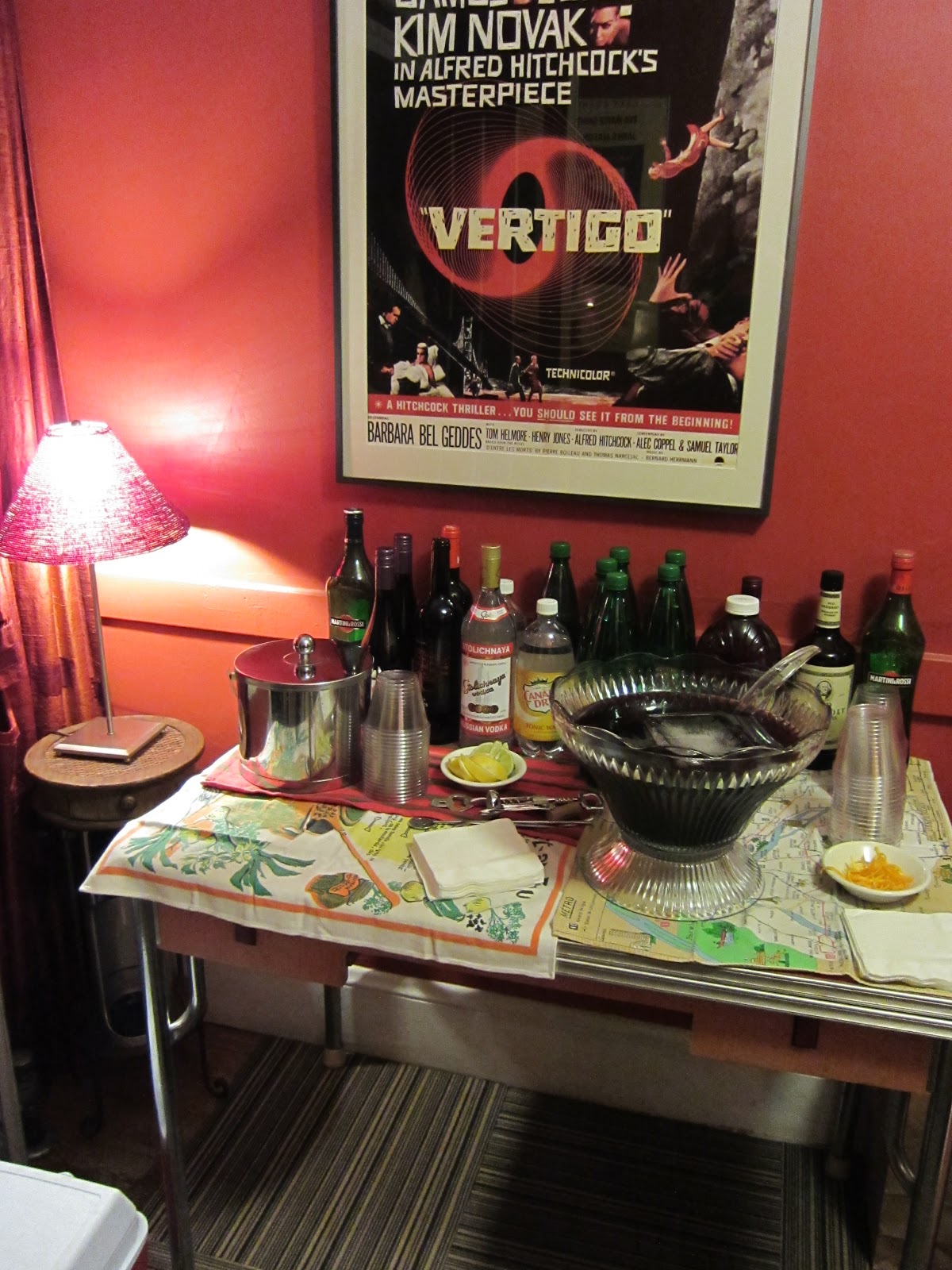
Punch is fun. And it makes an especially good party offering, as the hosts don't have to spend their evening "behind the bar," so to speak, but can mingle freely with their guests. Well, actually, it is usually only served at parties nowadays, though once upon a time it was a standard libation. You just don't see it that much anymore.

The main problem is finding punches that are interesting, and also not too sweet. Because so often, punches are made (or refreshed mid-party) by people who have already had way too much to drink - I am sure you have seen it: A soused host debonairly dumping sickly sweet rum into some sort of sickly sweet juice, concocting a recipe for one of the worst headaches in the world.

So, after some years, I have refined my list of punch recipes to just a few. And of those, these two are the best. They are deeply flavorful, complex, and not too sweet. They work wonderfully as holiday party punches, but are not limited to that service.

By the way, here is a good book about the history of punch by David Wondrich.

Without further ado:

Kentucky Cardinal Punch
Courtesy of Imbibe Magazine.

Says Imbibe, succinctly: "This punch from Kentucky bartender Kyle Higgins gets a strong fruity backbone from Southern Belle shiraz, a robust Australian wine aged in used Pappy Van Winkle whiskey barrels." 

It was incredibly difficult for me to track down this wine. Originating from Australia's R Wines Winery, I finally found a distributor in New York (and reasonably priced, too). I had a friend lug up a few bottles. In any case, I have not seen any since. I am sure nothing tastes quite like it (thanks to that aging in Pappy van Winkle bourbon whiskey barrels), so choose whatever bold wine you can find and don't expend energy on regret.


8 cups Southern Belle Shiraz, or other bold, spicy red
2 cups rye whiskey
2 cups brandy
1 cup sweet vermouth
1/2 cup Carpano Antica
1 lb granulated sugar
2 cups Moscato d’Asti
8 cups sparkling water
Ice block (freeze water in a Bundt cake or loaf pan)
Garnish with orange twists

Combine shiraz, rye, brandy, vermouth and Carpano in a pitcher. Slowly stir in the sugar until dissolved. Refrigerate for several hours until cold. When ready to serve, place ice block in punch bowl and pour chilled mixture over. Top with moscato and soda water and serve. Garnish each serving with an orange twist.
Makes approximately 50 servings.

Bourbon Punch with Pink Grapefruit and Mint
Courtesy of Melissa Clark, Bon Appetit. Makes 8 to 10 servings.

This is quite an interesting punch. Sort of a mix between a Mint Julep and Brown Derby. It is not too sweet, and has a tart, citrusy sparkle to it, thanks to the mingling grapefruit, mint, and club soda. The ingredients may seem a bit unusual, but this was a successful punch at one of my holiday parties. Very flavorful and with mass appeal. I doubled this recipe.
Hors d'oeuvres
  • 1/3 cup water
  • 1/3 cup sugar
  • 15 fresh mint sprigs, divided
  • 4 cups strained fresh pink grapefruit juice
  • 2 1/2 cups bourbon
  • 12 dashes angostura bitters
  • 1 cup club soda
Stir 1/3 cup water and sugar in small saucepan over low heat until sugar dissolves. Increase heat and bring to boil. Add five fresh mint sprigs. Remove from heat; cool syrup completely.

Strain syrup into punch bowl. Add juice, bourbon, and bitters; mix in soda and 10 mint sprigs. Add a block of ice to bowl.

A note about ice blocks: You want an arctic hunk of ice. While you can certainly buy blocks of ice, it is is easy to use a large Tupperware container, or as suggested above, a Bundt pan, to create a frozen block or ring of ice. Just freeze the water over night or longer to be sure it is solid! Have a backup ready, too, in case the first block melts too much.

If you are not serving the punch immediately, keep it refrigerated until you are ready to serve, and then add the ice to the punch bowl. Yes, you need a punch bowl. Bottoms up!

Whoa, whoa!

Tuesday, November 15, 2011

Romeo & Juliet Manhattan

Parting is such sweet sorrow...

The Romeo & Juliet Manhattan is simply a variation on the traditional Manhattan, albeit with something of a bittersweet tone, redolent of orange peel and darker flavors of leather, raisin, burnt sugar, violet, and nutmeg. This nuance is due to the tryst of Carpano Punt e Mes - an aperitif similar to sweet vermouth, but with a mild bitterness that brings to mind an amaro - and Carpano Antica sweet vermouth. These two combine nicely, tempering each other's more passionate qualities without losing their ardor. 

Similarly, the combination of Angostura and orange bitters highlight the bouquet of fruit and spice in both Punt e Mes and Carpano Antica.

Of course, all of this is happening under the all-encompassing embrace of bourbon. For those who find a standard Manhattan too sweet, this is worth a try.

The Carpano Antica and Punt e Mes are critical components to this, as they produce a harmonious interplay of flavors. Substituting the Carpano Antica will alter the character of the drink, but I realize it's not necessarily easy to find these bottles. So a regular vermouth could work instead. Punt e Mes should be easier to come by. 

Romeo & Juliet Manhattan

3 oz bourbon (Wild Turkey 101 is my choice)
1/2 oz Punt e Mes
1/2 oz Carpano Antica sweet vermouth
1-2 dashes Angostura bitters
1-2 dashes orange bitters (I recommend Regan's)

Stir all the ingredients with ice until nice and cold, and strain into a cocktail glass. Garnish with a cherry, skewered through the heart (O happy dagger, this is thy sheath).

Bottoms up.


Sunday, October 30, 2011

My Father's Manhattan

Simply put, my father makes the best Manhattan.

I don't know what makes it the best. It could be nostalgia. It could be the ratios, the precisely limited amount of bitters, the maraschino cherry juice (yes, the bright red kind). It could be the sheer consistency of the recipe - year after year, not one of these magnificent drinks has wavered in flavor. Each encounter with a Manhattan made by my father is like a reunion with your own flesh and blood. If there was one thing I could have learned from this, it is don't muck about with perfection.

So, like a proper son, I did muck about. And as a result, I lost the magic touch.

I used to make a good Manhattan; slightly more bitters, slightly more vermouth. In fact, in the quest to find my own take on this classic - my own perfectly rendered Manhattan - I have tried scores of different bourbons and ryes, many types of bitters and vermouths, and so many damned ratios that I have effectively forgotten how to make the same drink twice. I have made some outstanding cocktails, real beauties, with rich, complex flavors. I have made many that were merely so-so. The problem is, I have no standard to which I can adhere. I am always trying some new thing. It's hit or miss. Until, that is, I do it Dad's way.

That's why, in honor of my father's recent October birthday, I decided to write about his consistently delicious, soul-warming, old friend Manhattan. A chance to come home, so to speak. The Prodigal Son. It is like hitting the default button, starting over, finding the trail out of the wilderness. For me, it is the control in the experiment. It is the measure by which all other endeavors must be judged.

I would like to say I can remember the first time I was old enough to be offered my initial Manhattan. It was probably Christmas Eve. It probably came, as it always does, brimming with amber liquid and mystery, that dark cherry nestled deep in the glowing heart of the drink. Here was the special-occasion cocktail I had seen my father sip on for most of my life, always during gatherings or holidays. It represented festivity and camaraderie. It was always a libation indulged in as a group: the family raising a toast; a boisterous group of friends carefully clinking glasses, trying not to slosh. On trips to visit my mother's family in London, Dad would bring Wild Turkey, and would introduce the English relatives to this uniquely American cocktail. Everyone there who tasted it remembered it - such a cocktail was almost completely foreign to England at the time - and it was in demand at every visit, year upon year.

As for me, I loved it immediately. Spicy, sweet, floral, woodsy, each sip ushering a fugue of flavors, developing and restating themselves, from toasty vanilla to nutmeg and a mere hint of cinnamon, to something like burnt sugar and charred wood. Such a remarkable drink undoubtedly fostered my (quite possibly unhealthy) need to discover what transforms a good cocktail into a beautiful experience.

So here, a little over week past my father's birthday, I offer the king of Manhattans: Dad Bradley's.

My Father's Manhattan
  • 4 parts Wild Turkey 101 bourbon
  • 1 part sweet vermouth (Martini & Rossi)
  • Dash of Angostura Bitters
  • Small barspoon of liquid from the maraschino cherry jar
Note that I say parts, not ounces. The number of ounces that comprise four parts is up to you. Shake the ingredients with ice until very cold (about a 20-count) and strain into a chilled martini glass. Garnish with a maraschino cherry (and no, not the fancy kind... the artificially colored kind).

My brother, Ben, and father, Damon - happy with Manhattans
I have quite recently introduced my father to Carpano Antica, a particularly flavorful sweet vermouth, the "ancient formula," and Luxardo's fancy marasca cherries which are tart and delicious. And Dad politely agrees that these tastes indeed add new dimensions to the old classic Manhattan - and he may mean it. But ultimately, I like the Manhattan best when it is made the unfussy way Dad makes it: using the old, sticky bottle of Martini & Rossi, the trusty Wild Turkey 101, and the bright red cherries. And just a dash of bitters.

Here's to you, pops. (Forgive me if I don't say "bottoms up" this time.)

The Little Italy Cocktail

This cocktail was introduced to me by the bartender at Island Creek Oyster Bar in Boston's Kenmore Square (at which I spent far too much time - and far, far too much money) one evening in October. The fellow was an understated but skilled practitioner, and once he knew that the Manhattan was my favored cocktail, he was quick to suggest all manner of variations.

This libation was my favorite of the night, and I gleaned the recipe by watching him make it. It's basically a Manhattan with a rye base, but as the name suggests, the flavor of Italian ingredients transforms the old classic, capturing the essence of Manhattan's "Little Italy." It's one of those drinks that is very simple, but challenging in terms of ingredients: you should really use Carpano Antica Formula sweet vermouth, as it has a distinctive flavor that blends very well with the other hard-to-find ingredient, Cynar.

Cynar is an Italian artichoke-based bitter liqueur. I have found it locally at the ever-bountiful Cambridge Wine and Spirits, at the Fresh Pond Mall (you can also find the Carpano Antica Formula there, as well as the superb California vermouth "Vya"). The other place to look is Dave's Fresh Pasta in Somerville.

After a little research (and I stress a little because I am extremely lazy and my research is cursory at best - which means you should always exercise a healthy skepticism whenever I claim to know anything), I discovered that this delicious drink was created and named by one Audrey Saunders of New York's Pegu Club. And as Imbibe magazine says, "This cocktail is New York all the way. It’s the perfect expression of the neighborhood that Pegu Club’s Audrey Saunders named it for, with the American brawn of rye whiskey and the richness of Italian ingredients."

While you must have the Cynar, and finding the Carpano is highly advisable, the choice of rye is up to you. I used Wild Turkey 101 Rye in my version, because my favorite rye - Rittenhouse 100 - has seemingly become quite scarce in my neck of the woods. However, if you can find the Rittenhouse 100, it's called for in the original recipe, so I suggest going for that. You'll save a few bucks, as well.

Here is the monkey-exact, original recipe:

Little Italy Cocktail
  • 2 oz Rye whiskey (Rittenhouse 100 in the original)
  • 1/2 oz Cynar
  • 3/4 oz Carpano Antica Formula vermouth
  • Luxardo maraschino cherry in syrup
In a mixing glass with ice, stir the ingredients until very cold. Strain into a cocktail glass, and garnish with the cherry.

You can find good quality, flavorful cherries, such as the Italian Luxardo cherries in syrup, at the Boston Shaker, or at specialty liquor stores (or even online from Amazon.com). If you hate the bright red maraschino cherries found in supermarkets, then these are worth the extra $10 or $15. Otherwise, the others are fine for garnish.

Salute! Bottoms up.

Sunday, September 18, 2011

The Newark Cocktail

This past Friday, autumn arrived. Just two weeks into September, and crisp winds are rustling the leaves, the mornings are brisk, and we had our first touch of frost. I smelled a wood fire the other evening. And sitting here now, my chilly nipples are hard as diamonds. 

Yes, diamonds. What is this crap?

The Newark Cocktail
That distressing image now rooted in your mind, I will say that I actually rather enjoy autumn. The seasonal cuisine is good, I like the idea of tweed, there are bonfires, horror movies, Halloween, and a surplus of cocktails that make use of bourbon, rye, scotch, or, in this case, applejack.

Therefore, I am very happy to have discovered this enchanting, autumnal libation. It's woodsy, complex, a bit smoky, and has a hint of apple. It is the flavor equivalent of kicking through fallen leaves in an orchard, the odor of burning wood wafting through the bracing air, the last bite of apple still on the tongue. I've only made two and I am in love. If you like a Manhattan, you will probably enjoy this. It's worth having to buy the Fernet-Branca you'll need.

The cocktail is called the Newark, evidently, because it is a variation on the classic Brooklyn Cocktail - and according to the recipe, its creators (Jim Meehan and John Deragon of New York's Please Don't Tell) "didn't think the world needed another Park Slope cocktail. So they looked across the Hudson River instead and cheekily named it the Newark."

It is a most fitting name, too, since Laird's apple brandy and applejack (apple brandy blended with neutral spirits, somewhat similar to bourbon or rye, except apples are used instead of corn, wheat, or rye) have been distilled in good ol' New Jersey since 1780.

The Newark Cocktail
  • 2 oz Laird's applejack (or Laird's 100-proof, bottled in bond apple brandy - if you can find it)
  • 1 oz sweet vermouth (if you can find them, Carpano Antica or Vya add delicious nuances here)
  • 1/4 oz Fernet-Branca
  • 1/4 oz maraschino liqueur (I use Luxardo)
Combine all the ingredients with ice and stir until very cold and well mixed. Strain into a chilled cocktail glass. No garnish (though a lemon twist or a cocktail cherry would work).

Bottoms up!


Saturday, June 25, 2011

The Night Tripper Cocktail

On June 18, I disclosed the recipes for black peppercorn-infused vodka and my very own Dirty Cur Cocktail, a riff on the Salty Dog. And it was good. Since then, I have been playing mad scientist. The flavor of the infused vodka is rich and peppery, spicy and bold. The color is amber. It inspires experimentation. The flavor has real potential in cocktails.

I call this one the Night Tripper because I devised it while listening to Dr. John, The Night Tripper's Gris-Gris album, and it includes absinthe (popular in New Orleans). So there is a certain Crescent City-inspired atmosphere at work. Like Dr. John's debut album - a swampy, psychedelic, sultry, voodoo-sounding work of art (in my opinion) - this drink has mojo. It is
 spicy, mysterious, and satisfying. You can play around with the proportions and the supporting ingredients. And it packs a punch.


The Night Tripper Cocktail
  • 2 oz black peppercorn-infused vodka (recipe here)
  • 1 oz sweet vermouth (My choice is Carpano Antica Formula, but any sweet vermouth is fine)
  • Splash of absinthe (I use Kübler in this; also try Pernod, Herbsaint, or other absinthe substitute)
  • Dash Angostura Orange Bitters
  • Orange twist for garnish
In a chilled cocktail glass, add the absinthe and swirl to coat. Discard (and not into the sink, barbarian). In a shaker with ice, add the infused vodka, bitters, and the vermouth. Shake vigorously and strain into the cocktail glass. Add the orange twist.

Feel the mysterious flavors of the pepper and fruit, with the dark undertone of absinthe.

Bottoms up. Let me know what you think.


Sunday, May 15, 2011

The 1794 Cocktail

This cocktail commemorates the Whiskey Rebellion of 1794. A very brief overview: In the late 1700s, a tax was levied on whiskey in order to address millions of dollars in debt that had accrued under the Articles of Confederation, which prohibited taxation of states. As part of the new government that began operating in 1789 - after the ratification of the U.S. Constitution - Secretary of the Treasury Alexander Hamilton established the tax to help address the debt.

Famous whiskey insurrection in Pennsylvania (1880). Courtesy of NY Public Library.
The tax was highly unpopular among those on the western frontier of the U.S. It pitted the small, independent farmers and distillers of the west against the big companies back east. The western producers of whiskey protested the tax. They refused to pay, and were subsequently subpoenaed by the government. This eventually led to the Battle of Bower Hill in Pennsylvania - and loss of life. Clashes continued until the government finally prevailed in squashing the rebellion. You can read about this fascinating event in detail at Wikipedia (reservoir of all knowledge).

In the meantime, let's talk about the 1794 Cocktail. It's a delicious riff on the Boulevardier, composed of rye, Campari, sweet vermouth, and bitters. The original Boulevardier is a Prohibition-era drink made of bourbon or rye, Campari, and sweet vermouth. It is basically a whiskey-based Negroni (which is equal parts gin, Campari, and sweet vermouth).

The beauty of the 1794 Cocktail (which I understand was created by Dominic Venegas at "Range" in San Francisco) is that it allows for welcome variation in ratios. Campari is incredibly intense, and in my opinion, works better in the 1794 as an element of the drink rather than an equal partner. You also want a nice, spicy, solid rye that will stand up to the Campari while complementing it. Ryes I use in this are Wild Turkey 101, Rittenhouse 100, or Redemption Rye - all work well.

Vermouth-wise, I am happy using Noilly Prat Rouge, but even better is Vya sweet vermouth (out of California). You could try Carpano Antica Formula, but it's flavor is also intense and might be a bit much with the Campari. However, the beauty of this drink is that you can play around with the ratios and ingredients and see what happens.

As for the bitters in this drink, I read about using Bittermen's Xocolatl Mole Bitters from the Cocktail Virgin blog (which in turn credits "John from No.9 Park," a Boston restaurant). It just so happens that I received a bottle of this very bitters as a gift from close friends. It was a good excuse to experiment with this unusual but very pleasing cocktail - and I am incredibly glad that I did.

You'll find spiciness in the rye and a fruity note from the vermouth and Campari - cleanly undercut by the Campari's bitter finish. Surprisingly, the Xocolatl Mole bitters add a delicious undertone of gingerbread that suits this drink beautifully. It would be worth trying other bitters (orange would be a good match) as well.

A final note: My spouse, who cares not for Campari, loves this drink. So do not let any bias against that ingredient prohibit you from trying this!


The 1794 Cocktail
  • 2 oz rye whiskey 
  • 1/2 oz Campari
  • 1/2 oz sweet vermouth 
  • 1 or 2 drops of Bittermen's Xocolatl Mole Bitters 
Stir with ice until very cold, and strain into a cocktail glass. Garnish with a lemon or orange peel.

Bottoms up.


Monday, April 25, 2011

Blood and Sand Cocktail

On paper, the Blood and Sand Cocktail sounds wrong... Scotch whisky, cherry brandy, orange juice, sweet vermouth? Scotch in any mixed drink is an unusual concept. And the range of scotch - from fireside-smoky to heather-and-honey to seaside salt-wind and ocean spray - makes the outcome of this drink unpredictable yet always surprising. This is what makes the Blood and Sand so intriguing, and so worthy of experimentation in ratios and ingredients. Plus, this drink is appropriate any season (and any time of day). Just add a bit more orange juice in the morning.

Blood and Sand (with kirsch)
I have made a few of these in my time, usually with just stuff I have in the liquor cabinet or fridge. That means whatever blended whisky is on hand for guests (usually J&B or Johnny Walker); sweet vermouth (any will do); orange juice (fresh is best but if all you have is a carton in the fridge, that's fine too); and cherry brandy. Who has cherry brandy lying around? Well, many people have a bottle of kirschwasser on hand for cooking, and I have used kirsch in this drink and I have enjoyed it. It makes a cocktail with a light, "sand" color (since kirsch is colorless) and a slightly woody flavor mingling with the tart sweetness of the orange juice and the smokiness of the scotch.

Recently, however, I have thought more about the "cherry brandy" element. An article in the always-informative Imbibe Magazine piqued my interest in Cherry Heering, describing it as a "ruby-red liqueur made by soaking lightly crushed Danish cherries and a blend of spices in neutral grain spirits, then cask-maturing the mixture for up to five years, adding sugar during the aging process." The article goes on to clarify that Heering is not to be confused with kirschwasser or Maraschino liqueur. Cherry Heering is suggested for adding depth to classic libations such as the Singapore Sling or the Blood and Sand.

So I went out and looked for Cherry Heering, and managed to find it quite easily at one of my local liquor stores. The Blood and Sand using Heering is more robust, deeper-hued (a little blood mixed with the sand), and I would say has more mouth-filling depth of flavor. The Heering on its own is a deep red, and is richly flavored - tart but not sweet.

The recipe I follow for the Blood and Sand is from Gary Regan's Joy of Mixology. It is simple: equal parts. It suggests that any part could be increased or decreased for variations on sweetness or smokiness. Over time I have tried different whiskies in this cocktail, from J&B blended whisky to single malts. For my taste, a milder malt, with some smoke but not too much, is best in this drink. When I used a very peaty Islay single malt, it was a bit too smoky (though not unpleasant). I preferred a heathery highland malt, which added just the right smokiness and layers of honey to the drink.

Blood and Sand (with Cherry Heering)
Blood and Sand Cocktail
  • 3/4 oz blended scotch whisky (or single malt)
  • 3/4 oz sweet vermouth (any works, but try using Carpano Antica Formula or Vya, if you can find them; both add their own nuances to this drink)
  • 3/4 oz fresh orange juice (if you find blood orange, that would be appropriate)
  • 3/4 oz Cherry Heering (kirschwasser works too, but is quite different in flavor)
Shake with ice and strain into a chilled cocktail glass. Garnish with an orange peel if you so choose. 


Bottoms up!